
Anxiety and erectile dysfunction
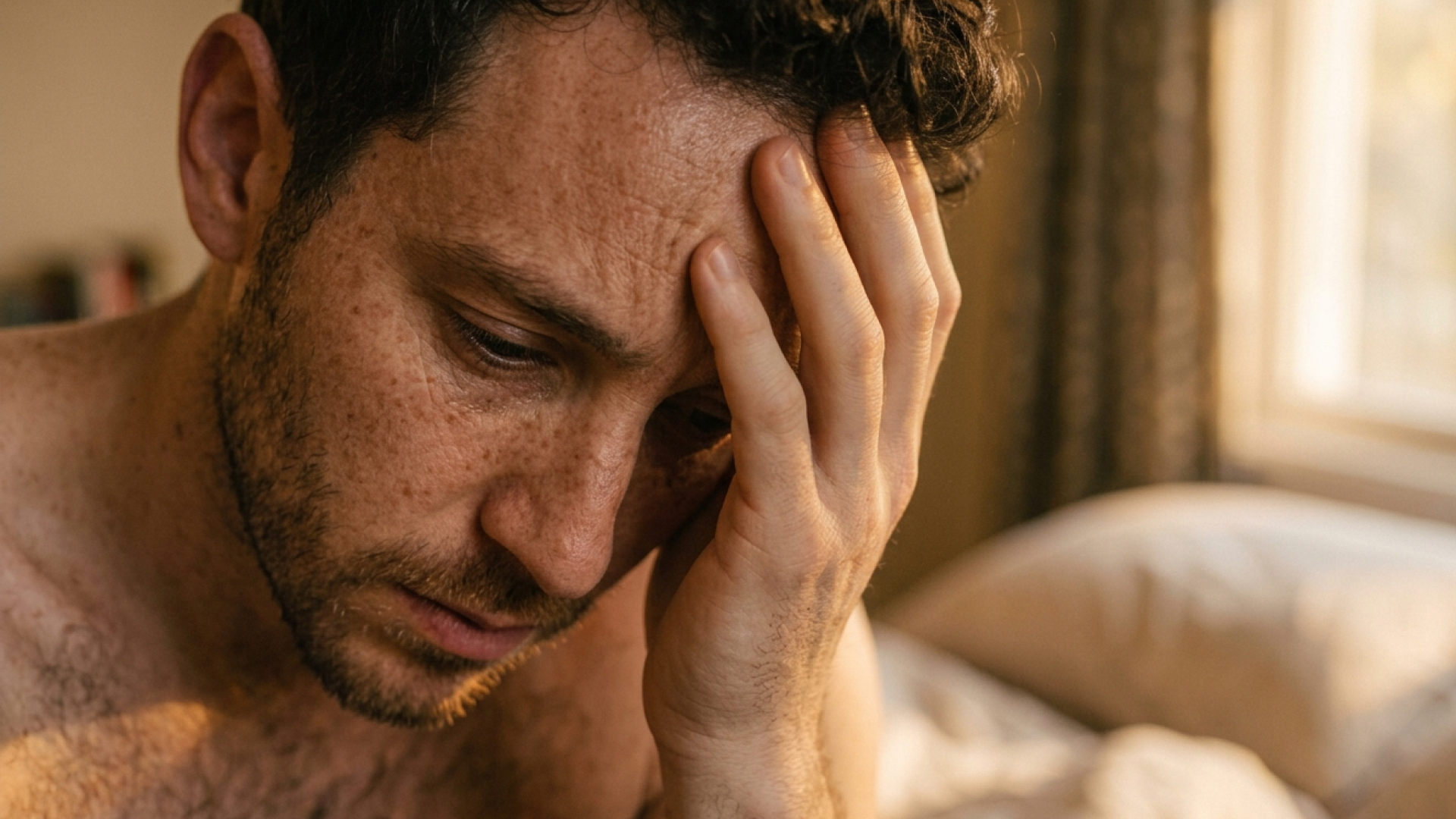

Yes, anxiety can cause erectile dysfunction (ED). When you feel anxious, your body switches into fight-or-flight mode, which pulls blood and focus away from arousal, so it gets harder to get or keep an erection even when your body is physically healthy (Nguyen et al., 2017).
The good news is that anxiety-related ED usually responds to the same tools that help with anxiety in general.
Can anxiety cause erectile dysfunction?
Yes. Anxiety and erectile dysfunction are closely linked, and the connection has a name: performance anxiety.
Your body has two nervous system modes. One, your parasympathetic nervous system, helps you feel calm and relaxed, and feeling relaxed makes it easier to become aroused. The other, your sympathetic nervous system, kicks in when you sense danger, real or imagined, and triggers the fight-or-flight response.
When you feel anxious before or during sex, your body can slip into this fight-or-flight mode. Blood flow shifts away from arousal and toward the muscles you'd need to run or fight. That makes it harder to get or keep an erection (Nguyen et al., 2017).
The anxiety-ED cycle
One tough experience in bed can start a cycle that feeds itself.
Here's how it usually goes. One time, you don't get or keep an erection, maybe because you were tired, stressed about work, or just in your head. Nothing serious happened, but you start to worry it will happen again.
That worry follows you into the next time you're intimate, and you may feel anxious before anything even starts. Your body senses that anxiety and reacts with the same fight-or-flight response, so the erection struggle repeats. Each repeat adds a little more worry.
This loop is called the anxiety-ED cycle. It comes from your nervous system reacting to a threat that isn't actually there. Once you see it as a loop, it gets easier to interrupt.
How common is anxiety-related ED?
It's common. Up to 30% of men under 40 have had erection difficulties at some point (Nguyen et al., 2017), and about 22% of men will have an anxiety disorder at some point in their life (Kessler et al., 2005). Anxiety also became more common worldwide during the COVID-19 pandemic, rising by 25% along with depression (World Health Organization, 2022).
If anxiety is playing a role in your erections, you're far from alone.
Anxiety-related ED vs. other causes of ED
Erectile dysfunction can have more than one cause, and the causes don't always show up the same way.
Anxiety-related ED, also called psychological erectile dysfunction or psychogenic ED, tends to be situational. Physical causes, like blood flow or hormone problems, tend to be consistent no matter the situation. The table below breaks down the main differences.
| Type of ED | What's happening | Typical pattern | What tends to help |
|---|---|---|---|
| Anxiety/performance-related (psychogenic) | Fight-or-flight response suppresses arousal | Situational: often fine alone or with a familiar partner, worse under pressure | Nervous-system regulation, therapy, reducing performance pressure |
| Physical (vascular/hormonal) | Blood flow or hormone levels affect erection | Consistent regardless of context or partner | Medical evaluation, treating the underlying cause |
| Medication-related | Side effect of a prescribed drug (e.g., some antidepressants) | Started after a medication change | Talking to the prescribing doctor before changing any medication |
| Mixed / co-occurring | Physical cause plus anxiety about it | Both patterns present together | Medical rule-out first, then anxiety-focused tools |
If you're not sure which pattern fits you, read how to tell whether ED is physical or psychological for a full breakdown. Keep in mind these causes can overlap. A physical cause can bring on anxiety of its own, which then makes the physical problem worse.
Ways to manage erectile dysfunction caused by anxiety
You can train your nervous system to calm down. A few approaches can help.
Learn how erections work. Erections naturally come and go, even during a single encounter. Knowing that one difficult time doesn't mean something is wrong can take a lot of the fear out of the next time.
Calm your nervous system first. Slow breathing and grounding exercises tell your body it's safe. Try breathing in for four counts and out for six, several times, before and during sex, to shift out of fight-or-flight and back into a state where arousal can happen.
Consider mindfulness-based practice. Early research suggests mindfulness-based practice may improve erectile function, though more trials are needed (Valderrama Rodríguez et al., 2023). Use it alongside the other steps here. A simple starting point is Mojo's community guide to mindful masturbation.
Talk to your partner. Anxiety about sex often grows in silence. Telling your partner what's going on takes the pressure off you both and makes it a shared problem.
Take the goal out of sex. When every encounter has to end in penetration or orgasm, the pressure builds before you've even started. Try sex without a goal for a while, and focus on touch and closeness.
When should you see a professional about anxiety and ED?
See a professional if this has been going on for more than a few weeks, if it's affecting your relationship or self-esteem, or if you're also feeling low or hopeless most days. Depression and anxiety often show up together, and a professional can help you work out what's driving what.
A few options, depending on what's going on:
- A sex therapist can help you understand what's going on, work through performance anxiety directly, and give you exercises to rebuild your confidence.
- A doctor can rule out physical causes first, like blood flow or hormone issues, especially if the pattern is consistent rather than situational.
- A psychologist or counselor, such as accredited COSRT and BACP therapist Amanda Barge, can help if anxiety is affecting more than just sex.
For a broader look at what's available once a physical cause has been ruled out, see Mojo's guide to ED treatment options.
How Mojo's Erection Reset helps with anxiety-related ED
The Erection Reset is Mojo's expert-led program for working with the stress response behind anxiety-related ED. It's built around nervous-system regulation and arousal conditioning, the same tools covered in this guide, structured into a step-by-step program led by Dr. Shannon Chavez.
The Erection Reset doesn't diagnose or treat ED as a medical condition. It gives you an evidence-based way to work with the anxiety behind it, at your own pace.
FAQs
Sometimes, especially if the anxiety was tied to one stressful period that has since passed. But once the anxiety-ED cycle takes hold, it usually needs active steps like nervous-system regulation, therapy, or a structured program to break it.
Talk about it openly instead of guessing what's wrong. Take the pressure off by removing the goal of penetration or orgasm for a while, and remind your partner that this is common and workable.
Yes. Depression and anxiety often occur together, and both can affect arousal and erections. Read the link between depression and ED for a closer look.
The main tools are nervous-system regulation, such as slow breathing, therapy with a sex therapist or psychologist, and reducing performance pressure during sex. A doctor should rule out a physical cause first.
It's usually temporary and tied to specific situations. It can become long-term if the anxiety-ED cycle isn't addressed, so the earlier you interrupt the cycle, the faster it tends to resolve.
Sources
- Kessler, R. C., Berglund, P., Demler, O., Jin, R., Merikangas, K. R., & Walters, E. E. (2005). Lifetime prevalence and age-of-onset distributions of DSM-IV disorders in the National Comorbidity Survey Replication. Archives of General Psychiatry, 62(6), 593-602. https://doi.org/10.1001/archpsyc.62.6.593
- Nguyen, H. M. T., Gabrielson, A. T., & Hellstrom, W. J. G. (2017). Erectile dysfunction in young men: A review of the prevalence and risk factors. Sexual Medicine Reviews. https://doi.org/10.1016/j.sxmr.2017.05.004
- Valderrama Rodríguez, M. F., Sánchez-Sánchez, L. C., García-Montes, J. M., & Petisco-Rodríguez, C. (2023). A scoping review of the influence of mindfulness on men's sexual activity. International Journal of Environmental Research and Public Health, 20(4), 3739. https://doi.org/10.3390/ijerph20043739
- World Health Organization. (2022, March 2). COVID-19 pandemic triggers 25% increase in prevalence of anxiety and depression worldwide. https://www.who.int/news/item/02-03-2022-covid-19-pandemic-triggers-25-increase-in-prevalence-of-anxiety-and-depression-worldwide
Mojo aims to provide useful wellbeing resources to its users; however, you should not solely rely on opinions or advice available on the Website or given by the Community. Always seek advice from a qualified medical doctor or other healthcare professional before acting.
About the experts

With 18 years as an accredited COSRT and BACP therapist, Amanda helps people navigate desire, intimacy, and the changes life brings.






Help is available when you're feeling low – you don't have to suffer in silence. If you're in crisis or struggling to cope, find someone to talk to on Find a Helpline.

