Does Toothpaste Help With Erectile Dysfunction?

.avif)
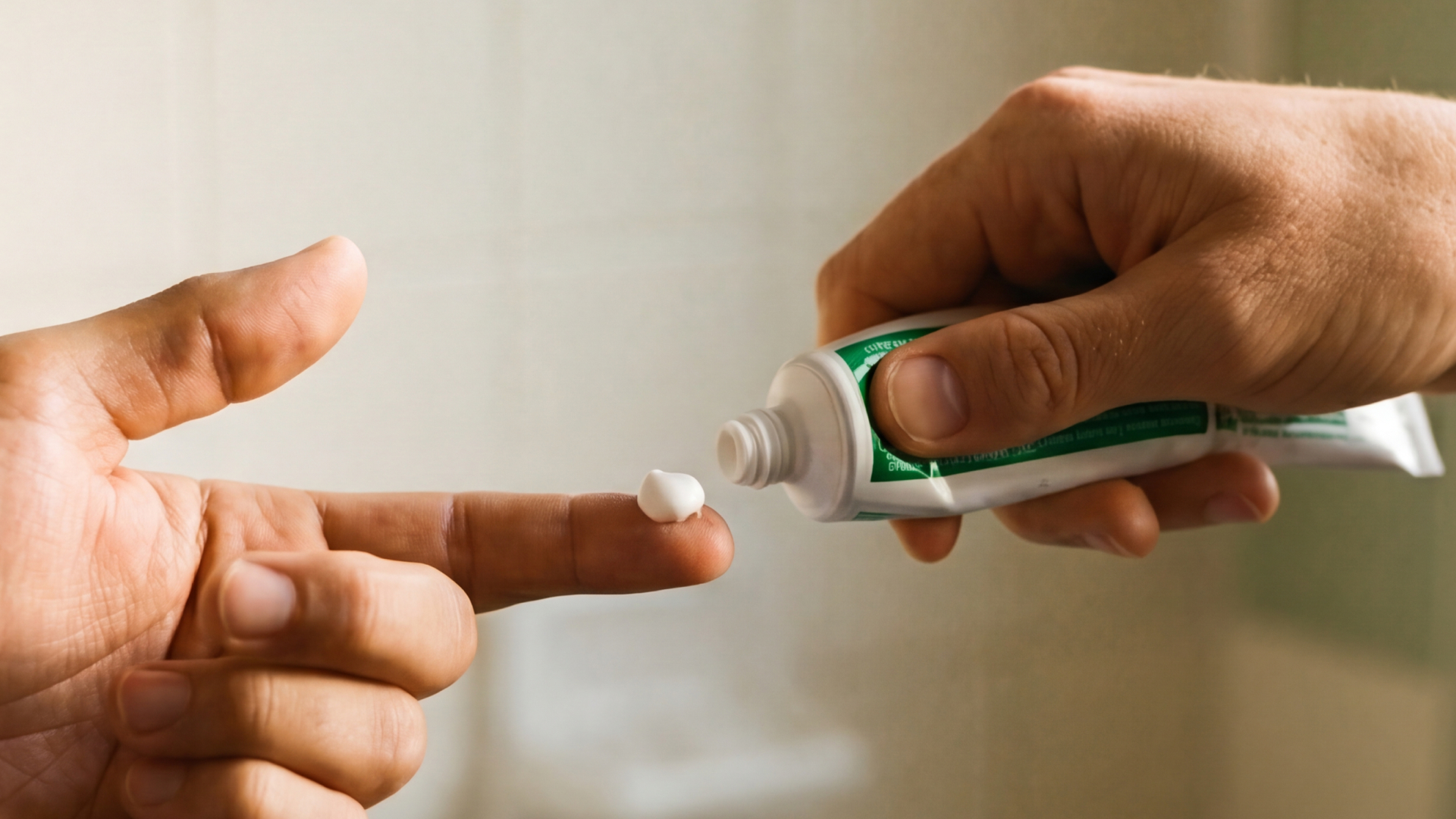

No. Toothpaste does not help with erectile dysfunction (ED), and rubbing it on your testicles or penis will not improve your erections or help you last longer in bed. Toothpaste is made to clean teeth, not treat genital skin, and using it down there can cause real irritation, burns, or blistering. If you're dealing with ED, there are treatments that actually work. Toothpaste isn't one of them.
Every month, people search online to find out if toothpaste can fix erection problems or help them last longer in bed. It can't. Below, we cover where the myth started, what toothpaste actually does to your skin, and how it compares to other viral “fixes.” For the bigger picture, our full guide to erectile dysfunction covers what actually works.
Does toothpaste help with erectile dysfunction?
No. Toothpaste has no effect on blood flow, nerve function, or anything else involved in getting or keeping an erection. It doesn't help with premature ejaculation (PE) either. No research supports the toothpaste trick for either condition (Healthline, 2020).
Dr. Shannon Chavez, the psychologist behind Mojo's Erection Reset course, sees why the myth spreads anyway.
A rumor like this offers a quick, private fix instead of that harder, more useful work. That's exactly why it spreads so fast online, even though it does nothing.
Where the toothpaste-on-testicles myth started
The myth spread through viral social clips, including a widely shared Top Gear bit where Jeremy Clarkson joked about rubbing toothpaste on his testicles. The joke picked up a second life online as a supposed performance hack.
The claim shows up in two versions that contradict each other. Some posts say toothpaste numbs the penis. Others say it stimulates it. Both claims can't be true, and neither has any clinical basis.
Why toothpaste irritates your penis and testicles
Toothpaste contains surfactants like sodium lauryl sulfate, along with mint, menthol, and whitening agents. All of them are chosen to clean and freshen your mouth, not to touch anywhere else. Dermatologists have documented these same ingredients causing irritant and allergic skin reactions on contact (DermNet NZ, 2024).
That research covers reactions on the mouth and skin around it, not a genital-specific study. But genital skin is thin and sensitive too, so the same irritants are a reasonable risk to expect there as well (DermNet NZ, 2024). A product built for tooth enamel and gums was never designed or tested for skin that sensitive.
The real risks of putting toothpaste on your genitals
Genital skin is thinner and more sensitive than the skin on your face or hands. That's why the reported harm here goes beyond mild discomfort. Doctors have reported burning, blistering, scarring, and pain in people who tried the toothpaste trick (IFLScience, 2019). These are reported cases from news coverage of real patients, not a controlled clinical study, but they line up with what dermatologists already know about how these ingredients behave on skin.
There's a partner-transfer risk too. If you don't wash it off before sex, your partner's skin is exposed to the same irritants.
Toothpaste vs. other viral “fixes” people try
Toothpaste isn't the only home remedy people pair with the lasting-longer myth. None of the others hold up any better.
| Viral “fix” | What people claim it does | Does it work | Risk / verdict |
|---|---|---|---|
| Toothpaste | Numbs or stimulates the penis to delay ejaculation | No — no clinical basis (Healthline, 2020) | Irritant contact dermatitis risk (DermNet NZ, 2024); burns and blistering reported (IFLScience, 2019) |
| Vaseline | Reduces sensation as a barrier | No evidence for ED or PE; used as a lubricant, not a treatment | Low risk on skin, but not designed for this use |
| Mouthwash | Numbs the penis via menthol and alcohol | No clinical basis | Alcohol content makes it a stronger irritant than toothpaste |
| Ice | Numbs the penis via cold | No evidence it changes ejaculation timing or erection quality | Risk of cold burns or frostbite with direct, prolonged contact |
| OTC numbing or delay sprays | Reduces sensitivity to delay ejaculation | A legitimate product category, unlike the others on this list, though evidence and dosing vary by product | Sold specifically for this use, so lower risk than the home remedies above |
Evidence-based ways to work on erectile dysfunction
The right approach depends on whether the cause is physical or psychological, and for a lot of younger men, it isn't physical at all.
Up to 30% of men under 40 have experienced erection difficulties (Nguyen et al., 2017). One study within that same review found up to 85% of ED cases in men under 40 were psychological erectile dysfunction (Nguyen et al., 2017). Stress, performance anxiety, and a nervous system stuck on high alert can all get in the way of an erection, even when everything down there works fine physically.
Dr. Chavez puts it simply: for a lot of men, the problem isn't the body's ability to get hard. It's the nervous system's brakes staying stuck on when they should release. That's a pattern you can retrain, not a life sentence.
That's the thinking behind evidence-based ED treatment options and behind Mojo's The Erection Reset course. Instead of chasing a fix for the wrong problem, it teaches you to work with the nervous system patterns actually driving your erection issues, so your body can respond the way you want it to.
Sources
- Healthline. (2020). Rubbing toothpaste on your penis won't make you last longer. https://www.healthline.com/health/does-toothpaste-help-last-longer
- DermNet NZ. (2024). Contact reactions to toothpaste and other oral hygiene products. https://dermnetnz.org/topics/contact-reactions-to-toothpaste-and-other-oral-hygiene-products
- IFLScience. (2019). Doctors warn people to stop putting toothpaste on their genitals. https://www.iflscience.com/doctors-warn-people-to-stop-putting-toothpaste-on-their-genitals-53962
- Nguyen, C. T., Gabrielson, A. T., & Hellstrom, W. J. G. (2017). Erectile dysfunction in young men: A review of the prevalence and risk factors. Sexual Medicine Reviews, 5(4), 508–520. https://doi.org/10.1016/j.sxmr.2017.05.004
Mojo aims to provide useful wellbeing resources to its users; however, you should not solely rely on opinions or advice available on the Website or given by the Community. Always seek advice from a qualified medical doctor or other healthcare professional before acting.
About the experts
With 18 years as a psychosexual and relationship therapist, Amanda helps people navigate desire, intimacy, and the changes life brings.

A medical doctor and Mojo's medical advisor, Matt keeps what you read about erections and physical health accurate and evidence-based.






Help is available when you're feeling low – you don't have to suffer in silence. If you're in crisis or struggling to cope, find someone to talk to on Find a Helpline.