Tantric masturbation for men: What it is and how to practice it
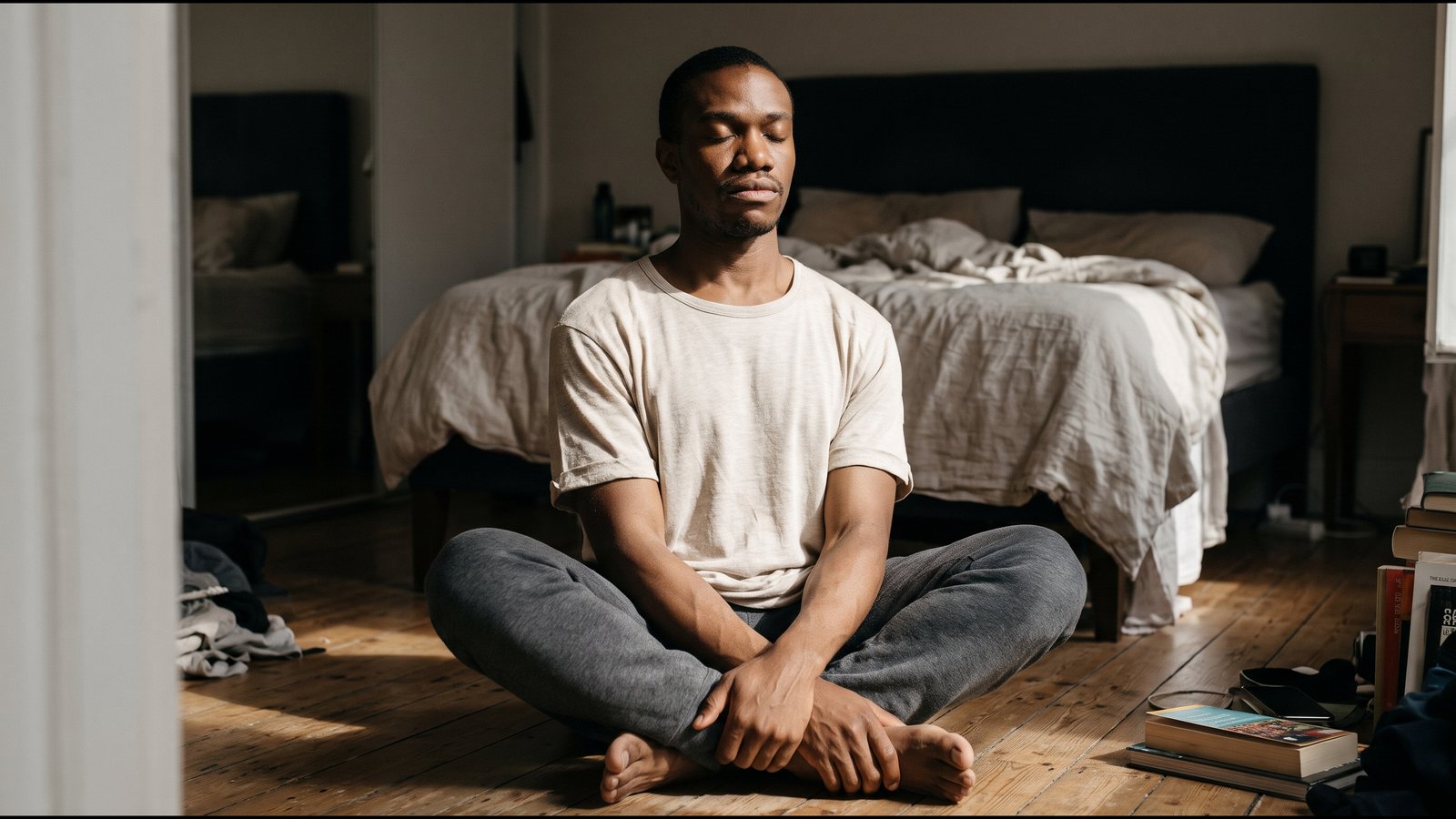

Tantric masturbation is a slow, mindful way to masturbate where you focus on breath and full-body touch instead of rushing to orgasm. The name comes from tantra, an old spiritual tradition, but the techniques overlap with sex therapy methods such as sensate focus and edging.
This guide walks you through the practical techniques, what the research says about them, and which popular claims you can skip. You don't need to buy into the spiritual side to try it, and you don't need any special kit or a free afternoon.
Where does tantric masturbation come from?
Tantra is a spiritual and philosophical tradition from Hinduism, Buddhism, and Jainism that goes back centuries (Britannica, n.d.). It's built around ritual and symbolism, and some schools of tantra teach that sexual energy can be turned into a kind of spiritual energy. That belief is where the sexual side of tantra comes from.
What most Western wellness sites call "tantric sex" is a newer version called neotantra, a 20th-century Western take on tantra built for a different audience (Urban, 2003). Neotantra borrows tantra's name and some of its imagery, but its techniques have little to do with the original tradition's beliefs. This guide covers neotantra's practical techniques rather than tantra's spiritual philosophy. If you'd prefer the same practice without the spiritual framing, our guide to mindful masturbation covers it directly.
Is tantric masturbation backed by science?
Partly. Tantric sex as a whole hasn't been studied, and its spiritual and energy claims, like moving sexual energy through your body, have never been tested. Some of the techniques it borrows have been studied in sex therapy, though the evidence is still limited.
The clearest example is sensate focus, a structured way of touching with no goal that sex researchers Masters and Johnson developed in the 1960s. Therapists still use it today to lower performance anxiety and rebuild body awareness (SMSNA, 2021). Mindful approaches like this can also boost arousal and help people feel less self-critical during sex, though that research was done in women, so treat it as a promising idea for men rather than a proven result (Brotto, 2021, as reported by SMSNA).
Edging, where you pause near climax and then start again, has a clinical version too. It's called the stop-start or squeeze technique, and therapists developed it to help with climax control (SMSNA, 2022). Small trials suggest these techniques can help some men take longer to reach climax, but the overall evidence is limited and not high quality (Cooper et al., 2015).
How do you practice tantric masturbation?
You set up a relaxed space, slow your breathing, explore your whole body, and pay attention to sensation instead of racing to orgasm. None of it needs a special mat, incense, or an hour you don't have. It works with whatever time and privacy you can find.
- Set the environment. Pick a time with no rush and no risk of being interrupted. Dim the lights if that helps you relax. The point is to take away any pressure to finish fast.
- Breathe and slow down. Take a few slow breaths before you start touching yourself. Slower breathing calms your body's stress response, and a calmer body tends to find arousal easier. That's general physiology, not a promise about a specific result.
- Use slow, full-body touch. Instead of going straight to your penis, spend a few minutes on your chest, stomach, thighs, and neck. Notice which kinds of touch actually feel good.
- Pay attention without chasing the finish. When you do touch your penis, focus on how it feels instead of tracking how close you are to orgasm. This is the same no-goal attention that sensate focus is built on.
- Try edging, if you want to. Bring yourself close to climax, then pause or ease off, then start again. Repeat a few times before you let yourself finish, or don't. Edging is optional, and it's most useful if you'd like to last longer.
What can tantric masturbation help with?
Slow, attentive masturbation can help with a few different things. Which steps you lean on depends on what you'd like to change, so the sections below are split by goal.
If you're not sure where you're starting from, understanding your own masturbation habits gives you a fuller picture of what's typical and what might be worth changing.
Can it help with performance anxiety?
Sensate focus was designed to lower performance anxiety by taking penetration and orgasm off the table, at least at first (SMSNA, 2021). Slowing masturbation down and focusing on sensation uses the same idea. Your body gets to feel arousal without a deadline attached, and steps 2 to 4 above do most of this work.
Can it help if you finish faster than you'd like?
This is where step 5 comes in. Edging is the part of tantric masturbation closest to the stop-start technique, which is the version with research behind it for lasting longer. Practicing it on your own, with no pressure, is a low-stakes way to get to know your body's build-up to climax.
Can it help if you struggle to finish with a partner?
This is a different problem, and it often comes down to masturbation style. Some men develop what researchers call an "idiosyncratic" style, meaning a grip, pressure, or speed that a partner's body can't match. One small study linked this pattern to delayed ejaculation and trouble reaching orgasm with a partner (Bronner & Ben-Zion, 2014).
That's the mechanism behind what's popularly called "death grip syndrome," a colloquial term for penile desensitization caused by frequent, high-pressure masturbation (ISSM, 2025). Here, the slower, varied touch in steps 3 and 4 matters more than edging. It's one straightforward way to retrain a pattern that's become narrow, without needing to stop masturbating altogether. Our guide to death grip syndrome goes deeper, and if you're curious about whether masturbation habits affect erections more broadly, we cover that separately too.
Can it help you change your relationship with porn?
It can be one part of it, but it won't fix the bigger picture on its own. If porn has become the main way you get aroused, slower, more attentive masturbation helps you build a wider range of ways to get there. If you're worried about porn and erectile dysfunction, we cover what the research says in a separate guide.
For longer-term change, Mojo's evidence-based Break Free From Porn program, built with Silva Neves, gives you the tools to work through what's underneath your porn watching. As Silva Neves, a psychosexual and relationship therapist, puts it: "Most of my patients don't have a porn problem. They have a life problem. Porn is just the only thing that's listening."
Tantric masturbation, edging, and sensate focus: how do they compare?
These practices overlap a lot in what you actually do with your body, but they come from different places and have different levels of evidence. Semen retention often gets lumped in with them, so it's included here too.
| Practice | What it involves | Evidence base | Mojo's take |
|---|---|---|---|
| Tantric masturbation | Slow, full-body touch, breath awareness, delaying orgasm, often framed with spiritual or energy language | No direct clinical trials. Overlaps with sensate focus and edging, which do have some evidence | Try the technique, skip the energy claims |
| Sensate focus | Structured, no-goal touch developed by Masters and Johnson | Used clinically to reduce performance anxiety and rebuild body awareness (SMSNA, 2021) | The best-evidenced building block here |
| Edging | Pausing stimulation near climax, then resuming | Clinical version (stop-start/squeeze) studied for early ejaculation. Small trials, limited evidence (Cooper et al., 2015) | A real technique, not just an internet trend |
| Semen retention | Avoiding ejaculation to supposedly raise testosterone or performance | No reliable evidence (see below) | Myth, skip this one |
Does semen retention make tantric masturbation more powerful?
No. There's no reliable evidence that avoiding ejaculation raises testosterone or improves performance, and the study most often cited for the claim has been formally retracted (Jiang et al., 2003, retracted 2021). You can get everything described in this guide regardless of how often you ejaculate.
Strict rules like this can turn masturbation into something you're always policing. If that sounds familiar, it may help to learn the difference between a habit and a compulsive pattern, since the two often get confused and lead to very different next steps.
Mojo aims to provide useful wellbeing resources and evidence-based information. This article is not a substitute for professional medical or psychological advice. If you're experiencing ongoing distress around masturbation, watching porn, or sexual function, always seek advice from a qualified medical doctor or licensed therapist.
FAQs
It's a slow, mindful way of masturbating, inspired by tantra, a spiritual tradition. The techniques involved, like full-body touch and no-goal attention, overlap with sex therapy practices such as sensate focus.
Give yourself unhurried, private time. Slow your breathing, spend a few minutes on full-body touch before focusing on your penis, and pay attention to sensation instead of rushing toward orgasm. Edging is optional.
No, but they overlap. Edging, where you pause near climax and then resume, is one technique tantric masturbation often includes. Tantric masturbation is the wider practice: breath, full-body touch, and a slower pace overall.
No. There's no reliable evidence that avoiding ejaculation raises testosterone or improves sexual performance, and the study most often cited for the claim has been retracted.
It can help you build a wider, more attentive range of arousal patterns, which is useful groundwork. It isn't a cure for erection issues or a fix for porn-related distress on its own. Mojo's evidence-based Break Free From Porn program, built with Silva Neves, helps you work through what's underneath that distress.
Sources
- Encyclopaedia Britannica. (n.d.). Tantra. In Encyclopædia Britannica. https://www.britannica.com/topic/Tantra-religious-texts
- Urban, H. B. (2003). Tantra: Sex, secrecy, politics, and power in the study of religion. University of California Press. https://www.ucpress.edu/books/tantra/paper
- Sexual Medicine Society of North America. (2021). What is sensate focus and how does it work? https://www.smsna.org/patients/did-you-know/what-is-sensate-focus-and-how-does-it-work
- Brotto, L. A., et al. (2021). The utility of mindfulness in sexual function (as reported by the Sexual Medicine Society of North America). https://www.smsna.org/news/smsna/the-utility-of-mindfulness-in-sexual-function
- Sexual Medicine Society of North America. (2022). What is edging and why do people do it? https://www.smsna.org/patients/did-you-know/what-is-edging-and-why-do-people-do-it
- Cooper, K., Martyn-St James, M., Kaltenthaler, E., Dickinson, K., Cantrell, A., Wylie, K., & Frodsham, L. (2015). Behavioral therapies for management of premature ejaculation: A systematic review. Sexual Medicine, 3(3), 174–188. https://onlinelibrary.wiley.com/doi/full/10.1002/sm2.65
- Bronner, G., & Ben-Zion, I. Z. (2014). Unusual masturbatory practice as an etiological factor in the diagnosis and treatment of sexual dysfunction in young men. Journal of Sexual Medicine, 11(7), 1798–1805. https://pubmed.ncbi.nlm.nih.gov/24674621/
- International Society for Sexual Medicine. (2025). What is "death grip syndrome" during male masturbation and how might it affect partnered sexual activity? https://www.issm.info/sexual-health-qa/what-is-death-grip-syndrome-during-male-masturbation-and-how-might-it-affect-partnered-sexual-activity
- Jiang, M., Jiang, X., Zou, Q., et al. (2003). RETRACTED ARTICLE: A research on the relationship between ejaculation and serum testosterone level in men. Journal of Zhejiang University Science, 4(2), 236–240. Retracted December 10, 2021. https://doi.org/10.1631/jzus.2003.0236
Mojo aims to provide useful wellbeing resources to its users; however, you should not solely rely on opinions or advice available on the Website or given by the Community. Always seek advice from a qualified medical doctor or other healthcare professional before acting.
About the experts

With 18 years as an accredited COSRT and BACP therapist, Amanda helps people navigate desire, intimacy, and the changes life brings.






Help is available when you're feeling low – you don't have to suffer in silence. If you're in crisis or struggling to cope, find someone to talk to on Find a Helpline.