Why can't I climax? Mojo's expert guide to anorgasmia in women


Anorgasmia, also called female orgasmic disorder, is the clinical term for ongoing difficulty reaching orgasm despite enough stimulation and arousal (ACOG, 2011). An estimated 3.4% to 5.8% of women meet that strict definition. Reported rates of general “orgasm difficulty,” a much broader category, range from about 8% to over 90%, depending on how researchers ask the question and who they survey (ACOG, 2011; Heshmatnia et al., 2025).
It comes in two forms. Primary anorgasmia means you've never orgasmed, under any circumstance. Secondary anorgasmia means you used to orgasm, and now you're struggling.
This guide explains what's going on and what can actually help.
What is anorgasmia?
The clinical term matters for one reason. It tells you this is a recognized, studied condition, named by medical bodies like the American College of Obstetricians and Gynecologists. If this is something you're experiencing, it's important to recognize that it isn't a failing of any kind, or something you're doing wrong.
Something is contributing to your orgasm difficulty, and in many cases, that something is identifiable and workable.
Solo orgasm vs. partnered orgasm: the gap, explained
For many women, achieving orgasm with a partner is more difficult than alone. About 95% of women can reach orgasm through masturbation (Shirazi et al., 2017), but only about 65% of heterosexual women usually-to-always orgasm with a partner (Frederick et al., 2018).
Knowing your own body and communicating that knowledge to someone else are two different skills. You can be fluent in one and still be learning the other.
Solo orgasm relies on understanding exactly what works for you, physically and mentally. Partnered orgasm adds a second layer: turning what you know about your own body into clear signals, spoken, guided, or shown, that another person can follow in the moment. Mojo's guide on how to make a woman orgasm walks through practical technique if you want to go deeper on that second layer.
Most women's most reliable path to orgasm runs through clitoral stimulation rather than penetration alone, and sex education almost never covers it clearly, for women or their partners. That gap in basic anatomy education compounds the communication gap. You can't easily guide someone toward something you were never taught to name for yourself. Practicing together, for example through mutual masturbation with a partner, is one direct way to close that gap, since it lets you show what works rather than only describe it.
Researchers call the difference between how often men and women orgasm during partnered sex, “the orgasm gap.” It isn't a women's problem or a men's problem. It's a cultural one, built from decades of sex education that centered male pleasure and treated female pleasure as an afterthought.
Mojo's Find Your Orgasm course, built with Dr. Mintz, was designed specifically for this gap: women who can orgasm alone but want that same reliability with a partner. It covers translating self-pleasure into partner pleasure, alongside the sexual communication skills that make it possible. If you want to see how other women are working through this, read what other women say about this in Mojo's community.
What causes anorgasmia?
Most causes are psychological, relational, or cultural, not purely physical. Anxiety, body image concerns, inexperience with your own anatomy, and sex-negative messaging absorbed over a lifetime all play a role, usually stacked on top of each other rather than acting alone.
Anxiety and stress are especially common contributors. Orgasm needs a nervous system relaxed enough to let arousal build without interruption. A racing mind, whether it's worrying about performance, your body, or how long you're taking, works directly against that.
Body image interferes in a similar way. If you're monitoring how you look during sex instead of noticing what you feel, that's attention orgasm needs and doesn't have. And plenty of women reach adulthood without ever learning their own anatomy in real detail, including their own clitoris, which makes it hard to guide anyone, including a partner, toward something you haven't fully mapped yourself.
Medication and certain life stages can also change orgasm ability. SSRIs and the hormonal shifts of menopause are well-documented causes of secondary anorgasmia (Clayton et al., 2019; Parish et al., 2019). That's a different, and treatable, situation from the cultural and educational causes this guide focuses on, and it's covered in Mojo's Find Your Orgasm course, built by Dr. Mintz alongside board-certified OB-GYN and certified menopause specialist Dr. Suzette Johnson.
Treatment options for anorgasmia
Yes, for most women, treatment helps, especially with secondary and situational anorgasmia. Directed masturbation, a structured, self-guided program of body-mapping and self-pleasure exercises, has the most consistent evidence behind it (Andersen, 1983; ACOG, 2011).
Here's how it works. Instead of hoping orgasm happens, directed masturbation walks you through learning your own arousal pattern on purpose: what kind of touch, pressure, and rhythm actually build toward orgasm for you specifically. Across the small outcome studies reviewed by Andersen (1983), roughly half to nearly all participants learned to orgasm through masturbation, with a smaller and more variable share going on to orgasm with a partner too. Those underlying studies are older and small by modern standards, so treat the method's logic, not its exact percentages, as the real takeaway. Mojo's guide to mindful masturbation covers a closely related technique if you want a practical starting point.
Mojo's Find Your Orgasm course builds directed masturbation into a guided, self-paced format, including a personal pleasure playbook you build as you go. If you're curious how other women have approached it, directed masturbation, as discussed in Mojo's community is worth a read.
The role of vibrators in treating anorgasmia
Vibrators help. About 52.5% of U.S. women report using one, and vibrator use is positively associated with better sexual function, including orgasm (Herbenick et al., 2009).
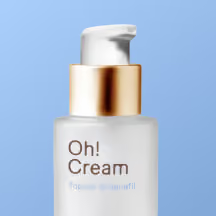
A vibrator is a tool that makes learning your own body faster and more reliable, the same way good running shoes don't replace training but make the training work. Pair it with directed masturbation practice, and you're combining the technique with the strongest evidence behind it with a tool that's already working for most American women. Arousal creams like Oh! Cream can play a similar supporting role if sensation, not just stimulation pattern, is part of what's getting in the way.
When to see a doctor about anorgasmia
See a doctor if your anorgasmia is new or sudden, started around the same time as a new medication, followed menopause, or comes with pain. Each of those points to a specific, identifiable cause a clinician can help you address directly.
Mojo's courses are evidence-based, expert-led education rather than therapy, and they don't diagnose or treat anorgasmia. If you want or need a formal diagnosis, that starts with a doctor. If a new medication or menopause turned out to be behind the change, Find Your Orgasm, built by Dr. Mintz and Dr. Suzette Johnson, is the Mojo course built for that specific situation.
FAQs
No. Anorgasmia is difficulty reaching orgasm despite arousal. Low libido is reduced interest in sex in the first place. The two can show up together, but they're different issues (ACOG, 2011).
Yes. Anxiety and stress are among the most common contributors, because a relaxed nervous system is part of what allows arousal to build into orgasm.
Usually not. Most anorgasmia has psychological, relational, or educational roots rather than a physical cause. It's still worth ruling out medication or hormonal factors with a doctor if it's new.
Yes. SSRIs are a well-documented cause of orgasm difficulty for some people (Clayton et al., 2019). If that sounds like your situation, it's a different, treatable one, covered in Mojo's Find Your Orgasm course, built by Dr. Mintz and OB-GYN Dr. Suzette Johnson.
No. You can start with education and self-guided techniques like directed masturbation right away. See a doctor if you want a formal diagnosis or suspect a specific medical cause.
Sources
- American College of Obstetricians and Gynecologists. (2011). Female sexual dysfunction (Practice Bulletin No. 119). Obstetrics & Gynecology, 117(4), 996–1007. https://www.aafp.org/pubs/afp/issues/2011/0915/p705.html
- Heshmatnia, F., Azizi, M., Milani, H., Nikbakht, R., Kheiri, M., Tolomehr, H., & Shahhosseini, Z. (2025). Prevalence and correlates of female sexual dysfunction and sexual distress in reproductive-aged women: A systematic review and meta-analysis. BMC Women's Health, 25, 451. https://link.springer.com/article/10.1186/s12905-025-03960-4
- Shirazi et al. (2017). Study on women's orgasm through masturbation. Archives of Sexual Behavior. https://doi.org/10.1007/s10508-017-1102-6
- Frederick et al. (2018). Orgasm frequency in a U.S. national sample. Archives of Sexual Behavior. https://doi.org/10.1007/s10508-017-0939-z
- Clayton et al. (2019). SSRI-associated sexual dysfunction. Cited in Mojo's internal course research. No public retrieval URL located; listed as plain text per evidence pack.
- Parish et al. (2019). Menopause and changes in sexual function. Cited in Mojo's internal course research. No public retrieval URL located; listed as plain text per evidence pack.
- Andersen, B. L. (1983). Primary orgasmic dysfunction: Diagnostic considerations and review of treatment. Psychological Bulletin, 93(1), 105–136. https://pmc.ncbi.nlm.nih.gov/articles/PMC3411116/
- Herbenick, D., Reece, M., Sanders, S., Dodge, B., Ghassemi, A., & Fortenberry, J. D. (2009). Prevalence and characteristics of vibrator use by women in the United States: Results from a nationally representative study. Journal of Sexual Medicine, 6(7), 1857–1866. https://academic.oup.com/jsm/article-abstract/6/7/1857/6834558
Mojo aims to provide useful wellbeing resources to its users; however, you should not solely rely on opinions or advice available on the Website or given by the Community. Always seek advice from a qualified medical doctor or other healthcare professional before acting.
About the experts
A medical doctor and women's health educator, Rugilė helps women understand periods, pain, and intimate health without myth or stigma.





Help is available when you're feeling low – you don't have to suffer in silence. If you're in crisis or struggling to cope, find someone to talk to on Find a Helpline.