Can women orgasm after menopause? (Plus perimenopause guide)



Yes, most women can still orgasm after menopause. Menopause does not switch off your ability to climax. A 2025 study published in the journal Menopause looked at more than 900 sexually active women between the ages of 40 and 79 (Sato et al., 2025). Researchers measured several parts of sexual function, including desire, arousal, lubrication, orgasm, and satisfaction. Desire, arousal, and lubrication dropped as the women got older, orgasm and satisfaction did not.
While the study did not say this directly, this could suggest that the parts of sex that lead up to orgasm can get harder to access with age, without orgasm itself becoming impossible.
This may be because menopause and perimenopause can affect vulvovaginal tissue and natural lubrication, causing dryness and discomfort, so arousal and orgasm may take longer or need a different kind of touch. Menopause can affect sexual function for many reasons, including hormonal, physical, and psychological changes (Heidari et al., 2019). But a change is not always the same as a loss.
This article is about orgasm changing after it was already part of your sex life. If you have never been able to orgasm at all, the causes and the path forward are different, and our guide on anorgasmia in women covers that separately.
What might cause orgasm changes during menopause and perimenopause?
Pleasure and your ability to orgasm can depend on many factors. Estrogen is important for female sexual functioning. It helps keep vaginal and vulvar tissues healthy, elastic, moist, and well supplied with blood, and it supports protective bacteria. In perimenopause and after menopause, lower estrogen can reduce these effects (Carlson & Nguyen, 2026). Less elasticity and lubrication means friction and discomfort can show up where they did not before.
Many women avoid sex when it feels uncomfortable. If this is the case, speak to a healthcare professional, as they can help with vaginal dryness or other menopause symptoms.
It might mean the type of touch that used to work now needs more time, more direct stimulation, or a different kind of pressure.
Other things can affect sex during these years too, including:
- Pelvic floor changes can affect the muscle part of orgasm. A 2021 study of 252 perimenopausal women found that women with weaker pelvic floor muscles had more orgasm problems and lower sexual satisfaction (Zhuo et al., 2021).
- Sleep problems, hot flashes, mood changes, some medications, other health conditions, and relationship or life changes can each affect sexual response on their own (The Menopause Society, n.d.).
Some women also enter perimenopause already taking an antidepressant. Selective serotonin reuptake inhibitors (SSRIs) are closely linked to a harder time reaching orgasm (Jing & Straw-Wilson, 2016). When multiple causes stack on top of each other, the change can feel bigger than any one of them alone.
Perimenopause vs. menopause: what's different for your sex life
Perimenopause is the transition that leads up to menopause. It covers the years before your last period and the 12 months after it. During perimenopause, estrogen levels start to decline and fluctuate, which is why symptoms might feel so inconsistent from week to week (Mayo Clinic, 2026).
In the US, the median age for menopause is 51 (Vadakekut, 2026). Menopause itself is a single moment in time: the day 12 months after your last period. The time after that is called postmenopause. After menopause, estrogen levels are consistently lower (Mayo Clinic, 2026).
Perimenopause and postmenopause can both affect your sexual function, but lots of women report mixed experiences. Some notice a big drop in desire in midlife, some feel more interested in sex, and others notice no change at all (The Menopause Society, n.d.). One study suggests that orgasms might not be affected much, even as desire and arousal dip (Sato et al., 2025).
Does genitourinary syndrome of menopause (GSM) affect your ability to orgasm?
Genitourinary syndrome of menopause, or GSM, mainly affects comfort, lubrication, and arousal, not orgasm capacity itself. But it can still get in the way of sex.
GSM is the medical term for the vaginal, vulvar, and urinary symptoms that come from declining estrogen during perimenopause and after menopause. That includes dryness, irritation, and pain with sex. According to The Menopause Society, these changes may lead to pain or bleeding during sex, less sensation, and trouble reaching orgasm, which can then lower sexual desire and interest (The Menopause Society, n.d.). So if sex hurts or feels uncomfortable, you are less likely to want it, and that is a problem worth naming on its own and seeing a doctor about.
Sato et al.'s 2025 study also found that women who had had sex within the past 3 months reported fewer GSM-related vulvar symptoms than women who had had sex less often. That is an association, not proof that sex prevents GSM. The researchers did not test whether having more sex causes fewer symptoms, or whether women with fewer symptoms simply find sex easier to keep having. Either way, it is one more reason not to let discomfort push sex off the table without addressing it.
Tools and treatment options that can help
Some tools that might help include those that address blood flow, lubrication, and sensitivity directly, such as a lubricant or moisturizer, a vibrator, pelvic floor-aware exercise. Consulting your doctor will help you figure out which tool or tools are most suitable for you.
| Tool or option | What it mainly addresses | Note |
|---|---|---|
| Lubricant or vaginal moisturizer | Dryness, reduced natural lubrication | An over-the-counter, evidence-based first step. See our guide to arousal and orgasm creams for more. |
| Vibrator | Reduced sensitivity, longer time to arousal | An evidence-based tool that can help with orgasm changes |
| Pelvic floor-aware exercise | Blood flow, muscle tone | Self-directed; there are apps available to guide you |
| Everyday or sexual mindfulness practice | Getting out of your head during sex | Not a physical tool, but based on emerging evidence |
| Low-dose vaginal estrogen | GSM symptoms directly | Ask your doctor whether this is right for you |
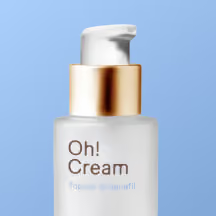
| Sildenafil cream | Blood flow and sensitivity | A topical prescription cream. US residents can buy Mojo's OB-GYN-formulated sildenafil cream, Oh! Cream, through our website. |
In some cases, mindfulness might matter just as much as the physical tools. Dr. Laurie Mintz, a licensed psychologist and certified sex therapist, has spent 30 years studying what actually helps women's orgasms, and goal-focus is one of the biggest blockers she sees. When you watch whether you are going to orgasm instead of paying attention to what feels good right now, that focus itself can get in the way.
This is exactly the gap Find Your Orgasm was built to close. The program covers both losing your orgasm and never having reached one, with a short questionnaire at the start pointing you to the track that matches your situation. OB-GYN and sexual medicine specialist Dr. Suzette Johnson and Dr. Laurie Mintz lead it together, one bringing the medical picture and one bringing the psychological one, to give you the full picture. It also includes access to a clinical consultation for women who want that extra layer of support alongside the practical tools.
Talking to a doctor about orgasm changes
See a healthcare provider if sex is painful, if dryness or discomfort does not improve with an over-the-counter moisturizer, or if the change in your sex life is distressing you. These things are treatable, not something you have to live with.
A doctor can rule out other causes, talk through options like low-dose vaginal estrogen, and check whether other factors, such as a medication you are already taking, are contributing to it. Mojo's Find Your Orgasm program does not diagnose or treat you directly, and it is not a replacement for that conversation with a doctor. Think of it as educational support, an expert-led next step alongside medical care.
FAQs
While the evidence is mixed, a newer study of more than 900 women found that orgasm ability and sexual satisfaction did not decline much with age, even though desire, arousal, and lubrication did (Sato et al., 2025). It is important to note this can vary from person to person.
Not necessarily. That said, perimenopause and menopause can affect your sexual function. Some women notice a big drop in desire in midlife, some feel more interested in sex, and others notice no change at all (The Menopause Society, n.d.).
Estrogen swings during perimenopause are one reason. They can affect blood flow and vaginal tissue, which can reduce sensitivity and lubrication. Sex can then feel uncomfortable or less pleasurable, which means you might need more time or a different approach (Mayo Clinic, 2026). Other things can play a part too, like sleep problems, mood changes, medications, and relationship or life changes (The Menopause Society, n.d.).
GSM is the medical term for the vaginal, vulvar, and urinary symptoms, like dryness, irritation, and pain with sex, caused by declining estrogen during perimenopause and after menopause.
They might. Vibrators are an evidence-based tool for increasing sensitivity and blood flow. They are a standard, positive part of a menopause-related orgasm toolkit, not a last resort. If you are not sure whether one is right for you, talk to your provider about whether it is worth exploring in your case.
Sources
- Sato, Y., Ozaki, Y., Tomoe, H., Ninomiya, N., Sekiguchi, Y., Yamamoto, M., & Takahashi, S. (2025). Cross-sectional study of the association between regular sexual activity and sexual function and genitourinary syndrome of menopause-related symptoms. Menopause, 32(7), 592–600. https://journals.lww.com/menopausejournal/abstract/2025/07000/cross_sectional_study_of_the_association_between.6.aspx
- Heidari, M., et al. (2019). Sexual function and factors affecting menopause: A systematic review. Journal of Menopausal Medicine, 25(1), 15–27. https://pmc.ncbi.nlm.nih.gov/articles/PMC6487288/
- Carlson, K., & Nguyen, H. (2026). Genitourinary syndrome of menopause. In StatPearls. StatPearls Publishing. https://www.ncbi.nlm.nih.gov/books/NBK559297/
- Zhuo, Z., Wang, C., Yu, H., & Li, J. (2021). The relationship between pelvic floor function and sexual function in perimenopausal women. Sexual Medicine, 9(6), 100441. https://doi.org/10.1016/j.esxm.2021.100441
- The Menopause Society. (n.d.). Sexual health. https://menopause.org/patient-education/menopause-topics/sexual-health
- The Menopause Society. (n.d.). MenoNote: Menopause and sexual function. https://menopause.org/wp-content/uploads/for-women/Menonote-Menopause-and-Sexual-Function.pdf
- Jing, E., & Straw-Wilson, K. (2016). Sexual dysfunction in selective serotonin reuptake inhibitors (SSRIs) and potential solutions: A narrative literature review. The Mental Health Clinician, 6(4), 191–196. https://pmc.ncbi.nlm.nih.gov/articles/PMC6007725/
- Mayo Clinic. (2026). Perimenopause: Symptoms and causes. https://www.mayoclinic.org/diseases-conditions/perimenopause/symptoms-causes/syc-20354666
- Vadakekut, E. S. (2026). Menopause. In StatPearls. StatPearls Publishing. https://www.ncbi.nlm.nih.gov/books/NBK507826/
Mojo aims to provide useful wellbeing resources to its users; however, you should not solely rely on opinions or advice available on the Website or given by the Community. Always seek advice from a qualified medical doctor or other healthcare professional before acting.
About the experts
A medical doctor and women's health educator, Rugilė helps women understand periods, pain, and intimate health without myth or stigma.






Help is available when you're feeling low – you don't have to suffer in silence. If you're in crisis or struggling to cope, find someone to talk to on Find a Helpline.